
The Academy Awards are announced tomorrow morning! So excited. Here's how I would like for them to stack up:
Best Picture:
1) Precious: Based on the Novel 'Push' by Sapphire
2) The Hurt Locker
3) Inglourious Basterds
4) The Fantastic Mr. Fox (might happen?)
5) An Education
6) Antichrist (no way in hell)
7) Away We Go (not going to happen)
8) Bright Star (doubtful)
9) (500) Days of Summer (maybe)
10) Up in The Air
* I think my 5 sketchy ones will be replaced by Invictus, Up, Avatar (sadly), District 9, and Crazy Heart
February 01, 2010

Why "The Hurt Locker Matters"
Kathryn Bigelow made history Saturday night. She became the first woman to ever win the Director’s Guild Award for Outstanding Direction in a Feature Film. Her movie The Hurt Locker has been dominating the awards circuit for the past few weeks. Although Bigelow has been a critic’s awards favourite, James Cameron was expected to take the win for directing Avatar.
Her win for The Hurt Locker is important for several reasons. It breaks the feeling that directing is a ‘boys club’. Bigelow hasn’t made her career out of directing flimsy romances or period dramas. She has chosen to direct tougher fare- suspense thrillers and action movies, genres which traditionally are done by male directors. The Hurt Locker shows that she knows how to play their game and do it much better than most of them.
 Director Kathryn Bigelow
It is worth mentioning that The Hurt Locker is an Iraq war film. This makes her win even more substantial. Out of the dozens of Iraq related films that have come out in the last decade, The Hurt Locker is the only one to have achieved any real critical and popular success (by which I don’t mean commercial, rather that audiences have responded well to it).
The Hurt Locker is also the lowest=grossing film of all the movies receiving major awards attention. It was given a poor limited release by Summit Entertainment over the summer. Most people are now discovering it on DVD due to excellent word of mouth. While Avatar has made nearly US$2 billion worldwide, Bigelow’s film has made about US$15 million.
The Academy Awards will be announced Tuesday. Bigelow is once again the frontrunner.
Back At It!
Hi Everyone!!
So I have resurrected the blog as part of an assignment for the social media class that I am taking while at Humber.
Feel free to take a creep from time to time.
-Brian.
So I have resurrected the blog as part of an assignment for the social media class that I am taking while at Humber.
Feel free to take a creep from time to time.
-Brian.
November 19, 2006
No Hole-In-One...
The great thing about being a huge packrat is that you always have piles of old magazines lying around just waiting to be rummaged through. I was thinking about what to critique today and felt a rummaging was in order. This advertisement that I found comes from the September 29, 2006 issue of Entertainment Weekly (I’m seeing a bit of a trend here…), and what it is is an ad for the Sony Cyber-shot (hmm…I’m seeing another trend here, cough cough Sony…). Take a look:

This ad is pretty racist. I’m surprised to see it taking place today really. It actually took me several moments to figure out what it was advertising. By the Zen like pose that the female subject is in, I thought it might be for some sort of herbal product or yoga, (but that would be too obviously stereotypical). As it turns out, Michelle Wie (the model) is a professional golfer. The peacock-like feathers are actually golf clubs. She isn’t dressed like a golfer though, which somewhat confuses me as to the purpose of this ad. What I do notice here however, is that this ad is severely guilty of orientalism. It places an Asian woman in a pose of meditation, which sells the stereotype of Eastern culture being spiritual and commodifies it to sell this product. What also makes this ad to be highly exotic is its’ colourization. Note the use of oranges and yellows, both are visually appealing and have ties with Asian exoticism. There is also the use of objects in this ad that make it to be other-worldly. The mat which Wie is sitting on alludes to be a large lily pad, which is referential to the Lotus, which comes from Buddhism (also Zen/enchanting). The golf clubs behind her are structured to be like a peacock tail. Peacocks are not part of everyday Western culture, so they are more of a novelty to the audience that is receiving this advertisement.
All of these factors within this ad make it guilty of cultural appropriation. Sony is using Asian culture, and stereotypes related to it in order to sell its’ product to the Western market. It does not take into consideration the context of Zen, meditation etc, just the fact that it is appealing to a Western culture because it is different than what we have here. This ad is terribly stereotypical and degrading to Asian culture just for the sake of selling a camera. With this and the previous Playstation3 ad I’m wondering what Sony won’t do for a dollar…
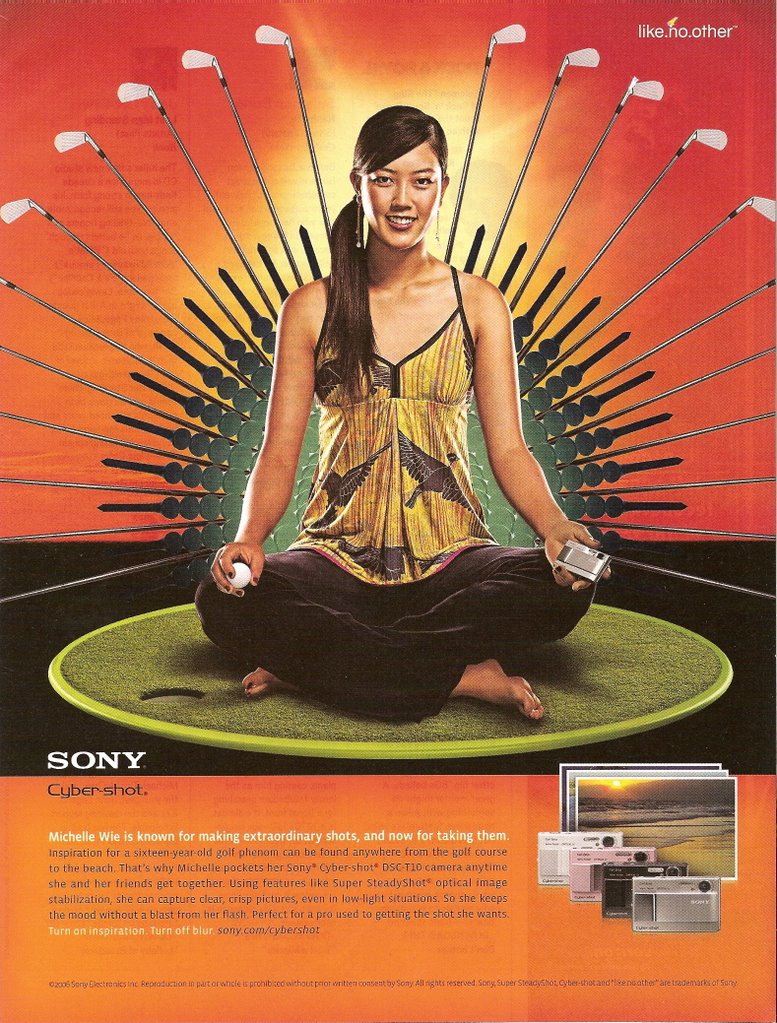
This ad is pretty racist. I’m surprised to see it taking place today really. It actually took me several moments to figure out what it was advertising. By the Zen like pose that the female subject is in, I thought it might be for some sort of herbal product or yoga, (but that would be too obviously stereotypical). As it turns out, Michelle Wie (the model) is a professional golfer. The peacock-like feathers are actually golf clubs. She isn’t dressed like a golfer though, which somewhat confuses me as to the purpose of this ad. What I do notice here however, is that this ad is severely guilty of orientalism. It places an Asian woman in a pose of meditation, which sells the stereotype of Eastern culture being spiritual and commodifies it to sell this product. What also makes this ad to be highly exotic is its’ colourization. Note the use of oranges and yellows, both are visually appealing and have ties with Asian exoticism. There is also the use of objects in this ad that make it to be other-worldly. The mat which Wie is sitting on alludes to be a large lily pad, which is referential to the Lotus, which comes from Buddhism (also Zen/enchanting). The golf clubs behind her are structured to be like a peacock tail. Peacocks are not part of everyday Western culture, so they are more of a novelty to the audience that is receiving this advertisement.
All of these factors within this ad make it guilty of cultural appropriation. Sony is using Asian culture, and stereotypes related to it in order to sell its’ product to the Western market. It does not take into consideration the context of Zen, meditation etc, just the fact that it is appealing to a Western culture because it is different than what we have here. This ad is terribly stereotypical and degrading to Asian culture just for the sake of selling a camera. With this and the previous Playstation3 ad I’m wondering what Sony won’t do for a dollar…
November 18, 2006
Checkmate.
Don’t you love it when something useful just falls into your lap? This happened to me yesterday. I got my issue of Entertainment Weekly (a week late…) and inside of it was this ad for the new Sony Playstation3.
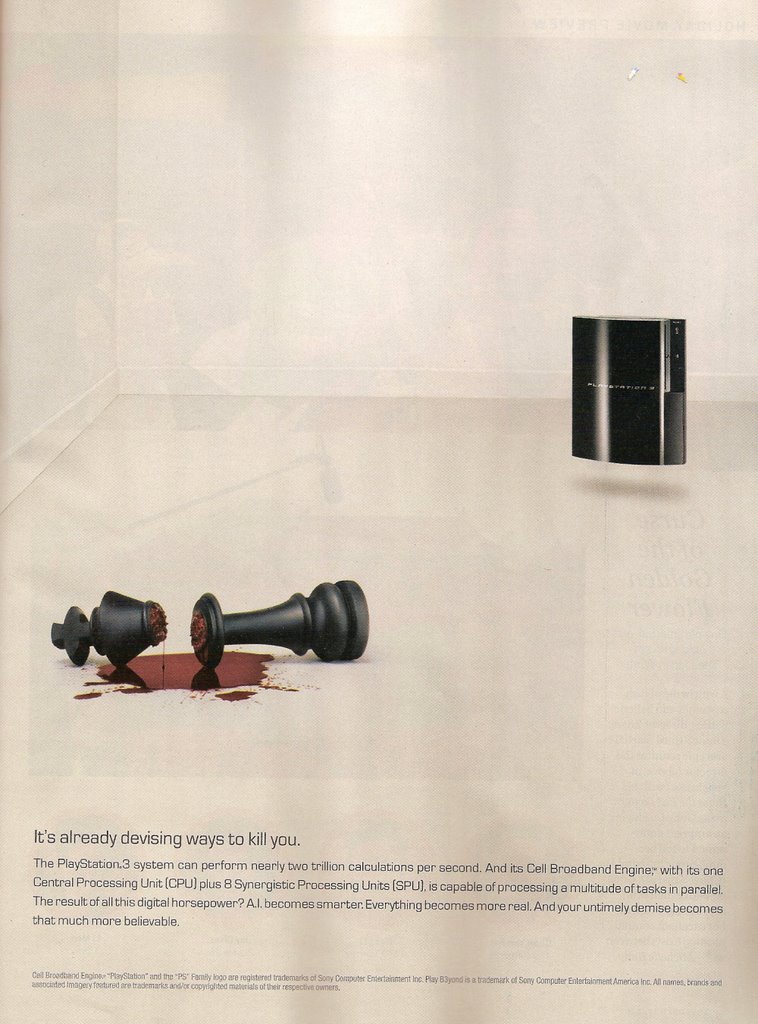
It shows the new Playstation in the background, and in the foreground there is a bishop piece from a game of chess that is decapitated and bloody. Under this piece’s ‘corpse’ is the ad-line ‘It’s already devising ways to kill you’. I think this ad is a bit much. I also think that it is for reasons like this that the term moral panic exists. I think that there is something extreme in decapitating a game piece that is traditionally not associated with violence. What this alludes to in terms of gaming, is that everything must be violent in order to sell and be amusing. This makes me think of what Henry Jenkins said in his article Lessons from Littleton: What Congress doesn’t want to hear About Youth and Media. He states that “teens aren’t drawn to [video games] because they are bloodthirsty or because they think violence is the best real-world response to their problems” (391), but this is apparently untrue according to the advertising executives at Sony. Apparently violence should be what you think of in order to win. I mean, you have to be ultraviolent in order to beat this new Playstation3, it’s programmed to kill you (in the gaming sense), and so you’d best be prepared. This ad also seems to bring an attack on ideas of what is tough and what is cool. Chess is typically viewed as a game of intellect, and with the chess piece dead; this ad can be seen as an attack on intellect for the sake of cool. Also, note that the chess piece is a Bishop, the chess piece with the most obvious religious connotation. The bishop has been beheaded in a visually appealing sleek and stylized manner. Religion, like intellect, is also not traditionally viewed as cool and exciting, therefore it must be destroyed to allow for play and for coolness. Attacking two such dominant ideas of importance will inevitably create moral panic, as those who establish what is morally offensive are usually intellects or religious officials. The consumers and appreciators of media that is deemed ‘morally inappropriate’ are the ones who enjoy the sexist and violent aspects that are evident. Therefore, this advertisement caters to them, and celebrates fun through violence. It seems that this ad clashes with Jenkins’ theory as it presents violence as the ‘best real-world response’ (91) to religious and intellectual ideologies. Check moral panic...
Subscribe to:
Posts (Atom)

